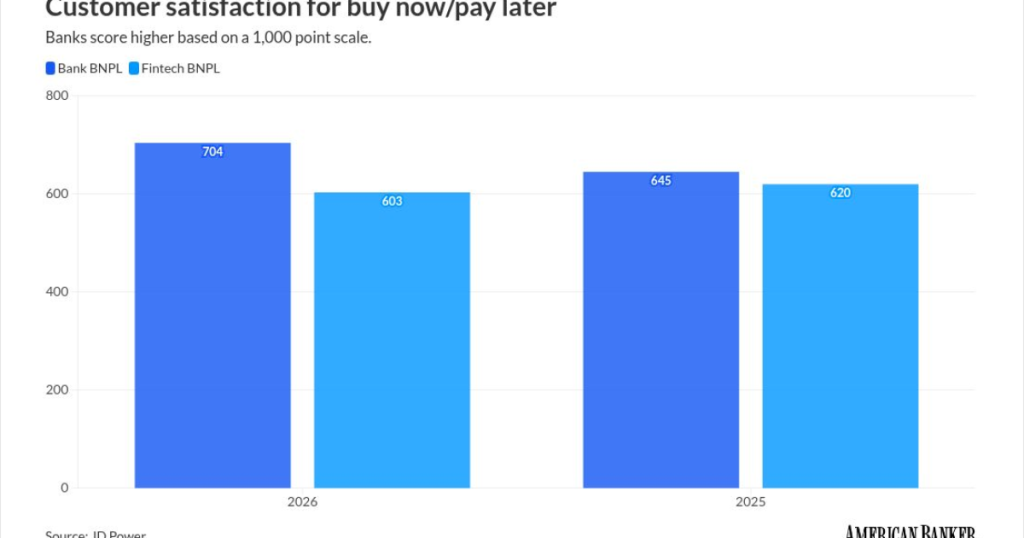
- Key insights: Bank BNPL has higher consumer satisfaction, according to JD Power.
- What’s at stake: The product has become more popular, particularly among young consumers. But many banks still don’t offer the product.
- Forward look: There is an opportunity for banks to reach receptive BNPL customers through marketing.
There’s good news and bad news for banks in
Processing Content
“There’s a huge, unmet demand for BNPL, and it’s being met for the most part by
A recently released
Here are six considerations for banks regarding this growing trend:
Bank satisfaction with BNPL is rising
The JD Power report, which tracks the country’s largest banks that offer BNPL, including JP Morgan Chase, U.S. Bancorp, American Express, and Citi, found that customer satisfaction rose significantly for bank brands: Though bank-branded BNPL is only a sliver of total BNPL spending, the average overall customer satisfaction score for bank-based BNPL services was 704 (on a 1,000-point scale), up 59 points from last year’s study.
Customer satisfaction with bank BNPL products has improved across every aspect of the experience, including repayment terms, digital account management, security, purchasing, customer support, and perks. By contrast, satisfaction with fintech BNPL products has declined across those same categories, according to Gelles. Customer satisfaction with fintech BNPL brands was 603, a 17-point drop from 2025.
A window of opportunity
BNPL is the fastest-growing payment method that JD Power tracks. It’s especially growing among consumers under age 40. About 50% of consumers under 40 are using BNPL, according to JD Power. This makes it a competitive necessity for younger customers, Gelles told American Banker.
Trust is a major factor when it comes to BNPL. Good service is also imperative, which many people feel they get from their banks, he added. “Offering these is table stakes” unless a bank is interested in losing its deposit customers to fintechs, he said.
Banks need to up their marketing game
With limited exceptions, these products aren’t heavily marketed by banks that offer them, Gelles told American Banker. Among customers using a BNPL service associated with their credit card, 52% decide to use a fixed payment plan after the purchase has already been made, while 48% decide at the time of purchase, JD Power found. This marks an opportunity for bank brands to build installment plans into the checkout experience.
Banks have to communicate that they offer these products, Gelles told American Banker. “Many people, especially in the under-40 demographic, know about Klarna, Afterpay, and Affirm. But many, many customers of larger financial institutions don’t even know that their banks offer these products,” he said.
The importance of debit-based products
Many banks offer credit-based BNPL options, but they should consider offering a debit-based solution, according to Gelles. Younger people, especially, prefer to use money that’s in their bank account or will be soon as opposed to racking up credit card debt, he told American Banker.
Notably, 64% of fintech customers link their BNPL payments to a debit card, according to JD Power.
Opportunities exist for smaller banks in the BNPL space
Community banks are increasingly offering BNPL through white-label providers or fintech partners. “For these smaller institutions, BNPL is a defensive necessity. If a local bank doesn’t offer a way to split a $500 emergency car repair, their customer will find a fintech that will,” Lane Greer, solutions engineering lead at Fullstory, wrote in an email.
Fintechs would like nothing better than to steal these customers from banks. “That first ‘split payment’ is often the first step toward a customer moving their entire primary deposit relationship elsewhere,” Greer wrote.
Banks need to think beyond BNPL alone
Many banks aren’t leveraging customers’ behavioral data the way they could, according to Greer. For example, most banks still treat BNPL as a siloed loan product rather than a window into customer intent. “They should be looking at the digital body language that leads a customer to choose BNPL in the first place. If a customer is consistently using BNPL for essential goods like groceries, that’s a behavioral signal of cash-flow stress,” he wrote. Tapping a variety of sources to understand customer behavior can help banks design more appropriate products and services. “An AI-native bank should use that data to offer proactive financial coaching or liquidity products before the customer is in trouble.”