American Banker’s 2026 Value of On-Chain Survey
American Banker’s 2026 Value of On-Chain survey was fielded online during February of 2026 among 199 banking professionals who work across a variety of roles at banks, credit unions, online-only divisions of traditional banks and unchartered neobanks.
Top findings from the report
Results from the report are highlighted below using interactive charts. Mouse over each section for more detail, click on the chart labels to show or hide sections and use the arrows to cycle between chart views.
This item is the start of a series diving into new research from American Banker. Click the links below to read the other parts of the overall research.
Processing Content
How are banks faring in the on-chain technology race?
Key takeaway: Failing to participate in the on-chain technology trend could mean losing a competitive edge.
Many banks are
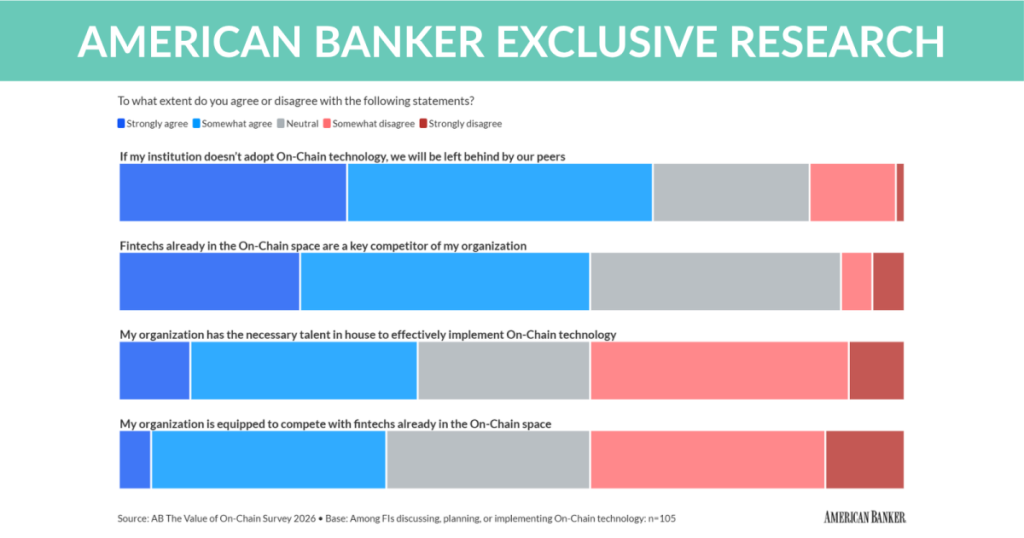
More than half of respondents (68%) agreed that failing to adopt on-chain technology in a timely manner will put them behind their peers. Roughly 20% neither agreed nor disagreed, and 12% disagreed with that perspective.
About 60% said fintechs already in the on-chain market are noteworthy competitors of theirs, while 32% were neutral and 8% disagreed.
About one-third (38%) of bankers are confident their organizations have the necessary talent in house for effectively executing on-chain technology adoption. However, 41% said they don’t have the necessary expertise for implementing this technology. Roughly 22% were neutral.
When it comes to competing against fintechs already established in the on-chain industry, 34% of bankers were confident that their organizations were well prepared. Close to half (40%) of respondents felt ill-prepared and 26% were neutral.
On-chain technology, like
At American Banker’s
Bank of North Dakota partnered with Fiserv to roll out its own stablecoin, called the Roughrider Coin, that the bank plans to use for bank-to-bank wholesale payments when it fully launches later this year.
“That differentiation becomes huge, especially in the banking world, because we are already used to payment rail systems with ACH and RTP and FedNow and wires,” Geloff said. “If we switch our thinking to, ‘How can an instantaneous payment rail system really help those customers?’ You start to think a little bit differently with your use cases. That’s why Venmo exists. That’s why PayPal exists. And now we’re trying to do those same things.”
Now is the time to launch on-chain products for clients
Key takeaway: About half of respondents feel clients are ready for on-chain products.
Roughly half of respondents (49%) are in agreement that banking clients are both ready and interested in products powered by on-chain technology. Close to a quarter of respondents (23%) don’t think clients are interested in such products or services and 28% were neutral.
Not all institutions or consumer bases are
“This is about: Who’s controlling the wallet? Who’s controlling the stores of value on behalf of the investor?” she said. “If it’s not the financial intermediary, then you’ve lost all access to the data, the client relationships, distribution channels. That’s the role we play.”
What are the main hurdles to on-chain technology adoption?
Key takeaway: Legacy systems and regulatory uncertainty are holding back financial institutions from accelerating on-chain plans.
Cost of implementation is just one hurdle of many banks and credit unions face on the path to on-chain adoption
The majority of leaders making the shift to on-chain rails (79%) cited regulatory uncertainty as a key hurdle during migration efforts. Roughly 14% neither agreed nor disagreed with the sentiment and 7% disagreed.
Legacy systems were also a top migratory barrier for close to three-quarters (72%) of bankers. Roughly 18% neither agreed nor disagreed with that perspective and 10% disagreed.
The inherent risk associated with digital assets gives many executives pause when deciding to get involved in the industry or integrate associated technologies, hence the desire for regulatory clarity first.
“This type of risk could be even more challenging to deal with as it’s not so much about things going wrong, as about who takes responsibility,” Acheson said. “Many may prefer that we stop the evolution of stablecoins and decentralized finance more broadly while we figure this out, but that would be a regressive mistake — evolution can’t wait for perfection.”
What will it take to kick off on-chain technology planning at institutions?
Key takeaway: Regulatory clarity is the top change needed before executives will advance on-chain adoption.
The uncertainty in the on-chain market has left executives at a standstill, but some changes could help kickstart adoption once again.
Regulatory uncertainty is a major friction point for bankers struggling to accelerate the pace of on-chain technology adoption within their institutions, as 40% of respondents said regulatory clarity is needed to quicken integration efforts.
Other notable needs for progress include customer demand/buy-in (22%), integration with existing systems (17%), talent acquisition (13%), widely-adopted industry standards (13%) and successful pilots (12%).
Policymakers with the Federal Deposit Insurance Corp. have
“Without these decisions, institutions cannot make informed strategic investments,” Wu said. “Macro policymaking, however, is only the first phase. What comes next — and what banks must now start preparing for — is the ‘micro phase’ of crypto regulation.”