- Key insights: Ripple is adding more payment processing technology for stablecoins and traditional currency.
- What’s at stake: The company is competing with the large card networks and payment fintechs in chasing a small but quickly expanding stablecoin market.
- Forward look: Celent’s Alenka Grealish estimates stablecoin payment adoption could reach double digits in some markets, but will likely not be mainstream.
With
Processing Content
The blockchain technology company has expanded its Ripple Payments service, which sells payments technology, adding more processing functions that can accommodate traditional and digital currencies in the same processing system.
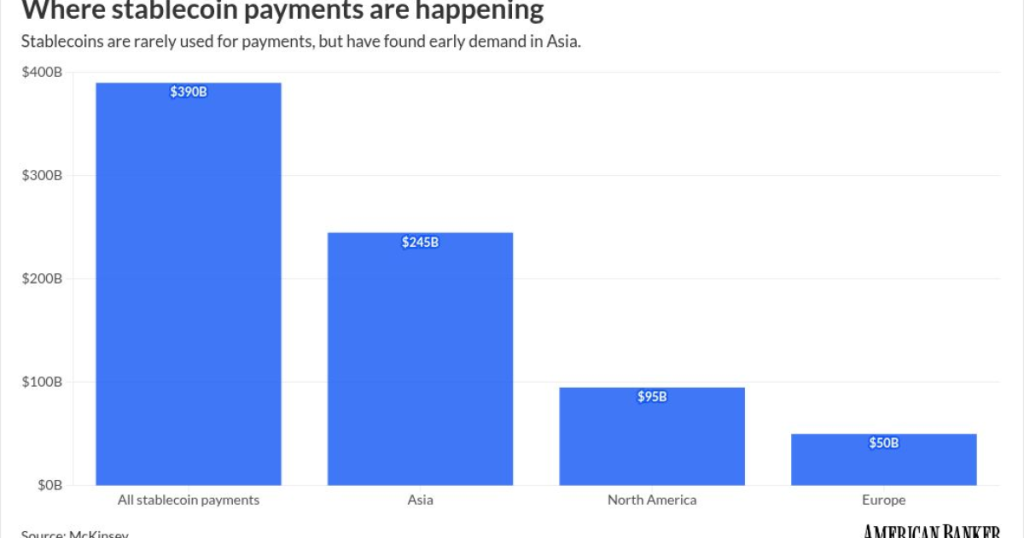
Ripple is adding new technology as stablecoin volumes expand — the total stablecoin volume has grown from about $133 billion to $310 billion in the last three years. While that’s
“Banks should pay attention to stablecoins because it’s getting a lot of attention,” Matt Higginson, a partner at McKinsey, told American Banker.
Ripple’s tools
That placed the company in opposition to traditional financial services. But more recently,
This week, Ripple is applying technology from earlier acquisitions of technology firms Palisade (which supports custody and treasury automation) and Rail (virtual accounts and collections) to enable users to collect, hold, exchange and make payments in stablecoins and traditional currencies.
“Stablecoins have quickly moved from experimentation to real-world payments infrastructure. As institutions look to move money across borders faster, they need platforms that deliver the speed, efficiency, and global access of digital assets with the compliance, liquidity, and operational reliability required for regulated finance. That’s why we’re seeing rapidly growing demand for end-to-end payments platforms that enable institutions to collect, hold, exchange, and payout value seamlessly across both fiat and stablecoin rails,” Aaron Slettehaugh, senior vice president of product for Ripple, told American Banker in an email.
Ripple contends this can automate processing and settlement without using multiple vendors or payment processors, a claim PayPal and Stripe are also making through a series of technology deployments in the past week.
“For the global financial system to evolve, fintechs and financial institutions need infrastructure that treats digital assets with the same rigor as traditional finance,” said Monica Long, president at Ripple, in a release, adding Ripple is live in more than 60 countries. “Success in this space requires enterprise-grade infrastructure, extensive licensing, and deep liquidity — capabilities few can match.”
Why payment companies like stablecoins
Ripple is not alone among payment firms that are investing heavily in infrastructure and marketing for stablecoins and related options such as tokenized deposits. In many cases, it’s a matter of keeping up with technology that may or may not become a major force.
“In general, these networks will always invest early in new technologies to maintain their relevance,” Olivia Haller, consultant at Cornerstone Advisors, told American Banker.
Stablecoin payments will likely not reach mainstream adoption, but be accepted by half of consumers, Alenka Grealish, an analyst at Celent, told American Banker.
“To assess the potential, one must look at the country level. Stablecoins’ real world value proposition varies dramatically by country and regulations, such as limits on value held and reward structure,” Grealish said, adding that without regulatory limits on stablecoins, usage could reach 16%.
For consumers and businesses in countries with high inflation and/or volatile currencies and/or currency controls, the value proposition of stablecoins as a store of value and medium of exchange are strong, according to Grealish.
“In these countries, the mainstreaming of stablecoins relies on regulators not intervening,” she said. “For example, if half the population of Argentina — about 23 million people — keep stablecoin deposits, there is a risk the government will limit usage.”