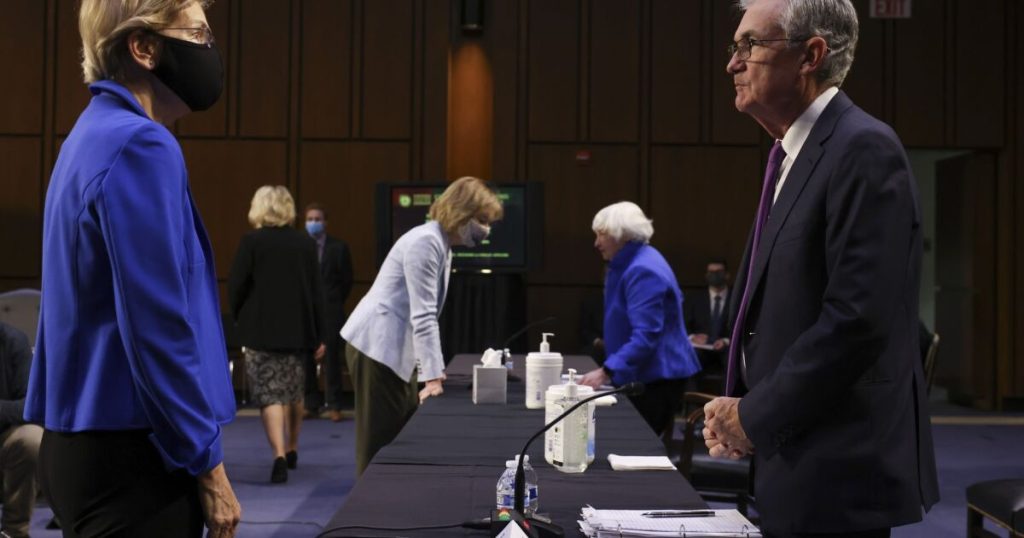
- Key insight: Senate Banking Committee ranking member Elizabeth Warren, D-Mass., warns top federal regulators against bailing out the crypto industry in the wake of sharply declining asset values.
- Supporting data: Bitcoin, the most widely-held cryptocurrency, has lost roughly half its value since October.
- Forward look: Warren is seeking a written pledge from the Treasury and the Federal Reserve that they will not offer assistance to troubled cryptocurrency firms.
Senate Banking Committee ranking member Elizabeth Warren, D-Mass., Wednesday pressed the top financial policy officials in the executive branch to commit to not bailing out cryptocurrency markets following a precipitous downturn in the digital asset market.
In a letter addressed to Treasury Secretary Scott Bessent and Federal Reserve Chair Jerome Powell, Warren urged the officials to avoid intervention, arguing a crypto-industry bailout would amount to a transfer of taxpayer dollars to wealthy crypto interests. Warren noted that President Trump himself is a prominent cryptocurrency stakeholder who would benefit personally from intervention through his influence over his family’s World Liberty Financial firm.
Processing Content
“Any government response to Bitcoin’s recent crash must be centered around bolstering safeguards for individual crypto holders,” Warren
The market for bitcoin has undergone a steep correction early this year, with prices dipping to just over $66,000 as of Thursday morning, down from over $120,000 at its peak in October. Bitcoin represents nearly 60% of the crypto market capitalization, making the sharp devaluation a potentially existential threat to the market. Warren says the correction, which “appears to be driven by a change in investor sentiment and shift away from speculative assets,” has led WLF, among other firms, to sell bitcoin-backed tokens in exchange for dollar-backed stablecoins.
A number of corporate holders of bitcoin, including Saylor’s Strategy Inc., saw its shares dip by roughly 20%, while individual investors like Binance founder Changpeng Zhao and Coinbase’s Brian Armstrong have experienced losses in the billions. Zhao received a presidential pardon from Trump after his company entered into business agreements connected to WLF. Warren has
Warren says the developments in the market should call for stronger focus on protecting consumers and not in bailing out the wealthiest crypto investors. The Treasury and Federal Reserve hold broad powers to offer liquidity to a wide range of firms — both banks and
“At a recent hearing, in an exchange regarding his authority to bail out the cryptocurrency industry, Secretary Bessent was asked whether ‘the money of our taxpayers … is … going to be deployed into crypto assets,'” Warren wrote. “Rather than giving a simple ‘no,’ he deflected, stating that ‘[w]e are retaining seized bitcoin.’ It’s deeply unclear what, if any, plans the U.S. government currently has to intervene in the current Bitcoin selloff.”
The Massachusetts senator urged the policymakers to forgo government-led guarantees or liquidity support for cryptocurrency firms experiencing turmoil and instead to step up regulation of the digital asset ecosystem, citing consumer vulnerability to scams, including a $17 billion reportedly lost or stolen due to crypto scams.
“According to Chainalysis, ‘Reported losses from Bitcoin ATM fraud have risen sharply in recent years, and older victims are disproportionately affected by these kiosk-based conversions,'” Warren noted. “While crypto ATM fraud constitutes a small portion of overall crypto-related losses, scammers stole more than $333.5 million from Americans using Bitcoin ATMs between January and November 2025. … Congress must act to address rampant fraud, provide commonsense consumer and investor protections, safeguard our national security, and address the President’s crypto corruption.”